Business Case for a District Fire Station based at Bell Block Gathers Momentum!
The case for a dedicated Bell Block fire station continues to build, and I believe the time has come for it to be treated with real urgency. Bell Block is one of the fastest-growing parts of the New Plymouth district, yet emergency response infrastructure has not kept pace with that growth. That is the central issue. As our community expands, so too do the risks, and it is becoming increasingly difficult to ignore the gap between what Bell Block needs and what is currently in place.

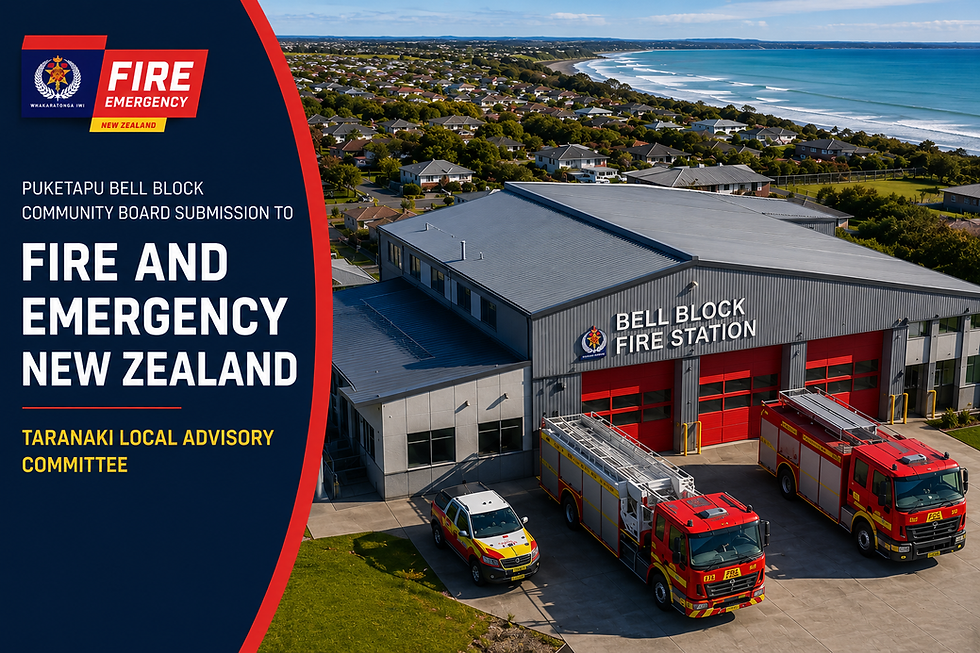
NOTE: AI Generated Image
At a previous council meeting, Carey Duggan presented evidence showing that response times to serious house fires in Bell Block could be in the order of 10 to 15 minutes, depending on traffic and conditions, with potentially serious consequences for residents, property and emergency crews. That evidence helped prompt Mayor Max Brough and New Plymouth district councillors to write to Minister of Internal Affairs Hon Brooke van Velden, warning that Bell Block’s population growth had far outpaced the expansion of emergency response infrastructure and created an unacceptable level of safety risk in the northern part of the district.
Support for change has also been reinforced through the Taranaki Local Advisory Committee process. TLAC chairperson Sam Bennett said the formal Puketapu Bell Block Community Board submission was endorsed by the committee and passed on to the Fire and Emergency New Zealand board within its formal role. That support adds weight to the argument that Bell Block’s growth, risk profile and service needs require a more substantial response.
New Plymouth Local Firefighters Union representative Carey Duggan has taken an even firmer position, describing a dedicated Bell Block station as “an absolute necessity” and saying the issue has remained unresolved for well over six years despite repeated advocacy and business case work.
That call for action is also being echoed within the wider fire and emergency network. Taranaki District Commander David Utumapu has said a career crew is his preferred option, alongside other changes to the FENZ network in North Taranaki. To me, that reinforces the point that, while staffing models are still being worked through, there is growing recognition that Bell Block needs a stronger local emergency response capability.
In her reply to the council, Hon Brooke van Velden acknowledged the concerns raised, but made it clear that operational decisions sit with Fire and Emergency New Zealand and remain subject to national planning and available funding. She said she had been assured that the growth, risk profile and operational demand associated with Bell Block would be considered as planning progresses. That is encouraging, but it also underlines the need to keep building a strong, united case.
I do not see this as a Bell Block-only issue. It should be viewed as part of a broader district-wide business case that considers Bell Block alongside New Plymouth, Waitara, Inglewood and the wider North Taranaki emergency response network. Investment in Bell Block would not simply benefit one suburb; it would strengthen resilience across the wider district, now and into the future.
That is why I believe this issue matters not only to Bell Block residents and businesses, but to the wider community as well. Public support, submissions, letters of endorsement and community advocacy can all help strengthen the case for a response that matches Bell Block’s growth, risk profile and importance to our district.
However, we also need to be realistic. Even with a strong business case, Bell Block is competing with communities across New Zealand for limited national funding. If we want to elevate our district’s needs, we must be proactive and present solutions that are both practical and compelling.
One option worth exploring is a community-led partnership model. This engagement has already been kick-started by Cr John Woodward with philanthropic prospective partners, so rather than relying solely on traditional funding pathways, our district could investigate whether land, construction services, materials, or even a completed facility could be provided locally to Fire and Emergency New Zealand specifications. FENZ would still determine operational requirements and staffing, but reducing the capital cost barrier could significantly strengthen the case for investment in Bell Block.
Imagine if the community, local businesses, landowners and industry partners came together to help deliver the station infrastructure, with FENZ contributing the operational capability needed to run it. Such a partnership would demonstrate not only the need for a station but also the community’s willingness to be part of the solution.
This is not a replacement for government investment. It is an innovative way to help accelerate it.
If you can assist through land, professional services, construction expertise, materials or other support, John or I would welcome a conversation. Bell Block has never lacked community spirit. Perhaps that same spirit can help deliver the emergency response infrastructure our growing district needs for the future.
By Adrian Sole, Chairperson, Puketapu Bell Block Community Board
A huge Thank You to Bec's Wallis the Editor of the Round the Block magazine that published this article in Issue #9 July 2026
Comments